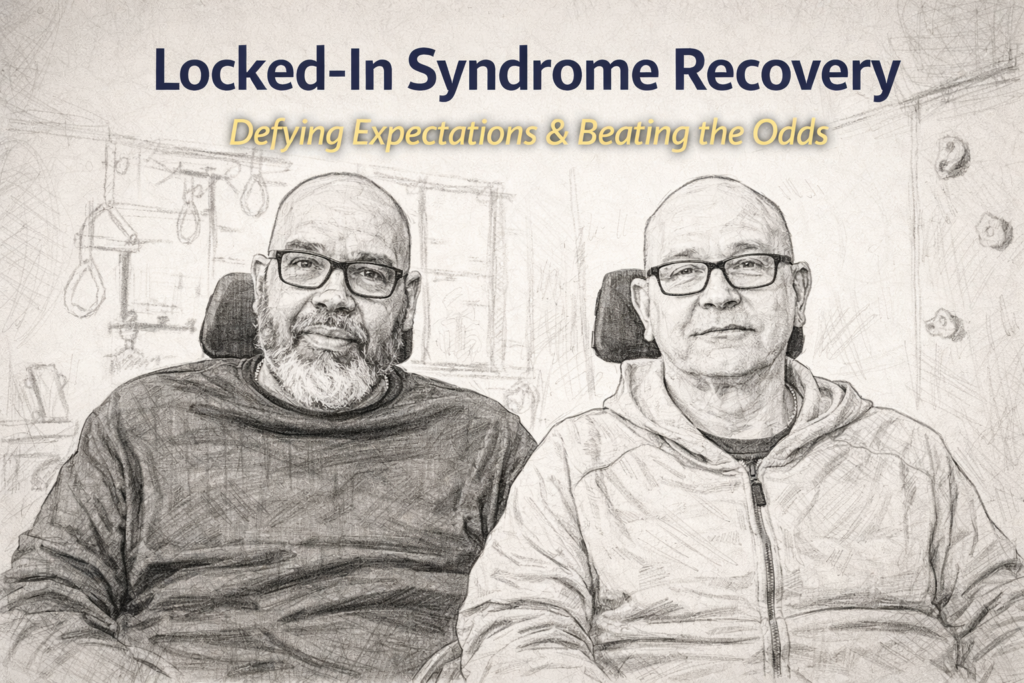
Locked-In Syndrome (LIS) is often viewed through a lens of permanence and limitation. However, at Next Steps Chicago, we are dedicated to challenging those limitations and rewriting the possibilities for neurological rehabilitation. We recently shared the incredible journey of two of our patients, Rudy and Darryl, on our Facebook page, showcasing what is possible when hope is paired with expert, intensive neuro-rehabilitation.
Here is a closer look at what Locked-In Syndrome is, how we approach treating it, and why Next Steps Chicago is a trusted authority in complex neuro-disability recovery.
Understanding Locked-In Syndrome (LIS)
Locked-In Syndrome is a rare and severe neurological condition typically caused by damage to the brainstem. A person with LIS is fully conscious, aware, and able to think, hear, and see, but they are completely paralyzed and unable to speak. Effectively “locked” inside their own bodies, patients usually only retain the ability to move their eyes vertically or blink to communicate.
Because of their profound physical paralysis, people with LIS are fully dependent on others for all their daily care. However, it is crucial to understand that in classic LIS, a patient’s cognitive and intellectual functions remain largely intact. This means that physical rehabilitation and alternative communication strategies are essential to helping them regain a high quality of life.
Rudy and Darryl: Defying Expectations
Rudy and Darryl are two remarkable patients who survived LIS and are defying every expectation associated with the condition. Through sheer determination and intensive, one-on-one Physical Therapy (PT) and Occupational Therapy (OT) at Next Steps Chicago, they have achieved milestones that highlight the power of targeted rehabilitation:
- Starting from eye-gaze communication
- Progressing to small but powerful muscle activation
- Transitioning into controlled, meaningful movement
- And now taking steps toward mobility
Every milestone they reach is a profound victory and a testament to their resilience.
How Next Steps Chicago Pioneers Neuro-Rehab
At Next Steps Chicago, our mission is to provide the neurological community with dynamic, affordable, and progressive rehabilitation. We are the first free-standing, non-profit physical therapy facility uniquely devoted to people living with the most devastating neurological injuries.
We establish our authority in treating complex conditions like LIS through our comprehensive, technology-driven approach:
- One-on-One Expert Therapy: We provide individualized PT and OT sessions with highly skilled, licensed therapists. Physical therapy is an absolute imperative for gaining strength and enhancing range of motion, while occupational therapy focuses on improving the motor skills necessary for meaningful daily activities.
- Encouraging Neuroplasticity: Our facility utilizes a myriad of active therapy options specifically designed to reverse muscle atrophy, encourage neuroplasticity, and help patients regain lost function.
- Advanced Therapeutic Technology: Patients have access to world-class equipment that cannot be found in a standard clinic. This includes the Lokomat, a robotic-assisted body-weight-supported treadmill for physiological gait training, the RT 300 FES Cycle for neuromuscular recovery, and the Xcite functional electrical stimulation device.
- First-in-Class Innovation: We are proud to be the very first outpatient clinic in the United States to integrate STROLLL Augmented Reality Goggles to visually stimulate and improve walking and balance, as well as the ONWARD ARC-EX spinal cord stimulator to improve strength and sensation.
- Alternative Communication: For patients with LIS, establishing a reliable form of communication is paramount. Our team understands how to incorporate Augmentative Assistive Communication (AAC) devices, such as eye-gaze systems and alphabet boards, to ensure our patients’ voices and choices lead their rehabilitation journey.
Healing Happens Here
Next Steps Chicago is committed to fostering an environment where research, education, and clinical trials drive our ambition to redefine recovery. We believe that every session is an opportunity to break barriers and push past the conventional limits of complex neuro-disabilities.
If you or a loved one is navigating a severe neurological condition like Locked-In Syndrome, you do not have to walk that path alone. Healing happens here. Hope lives here. Progress starts here.
To witness Rudy and Darryl’s incredible progress, watch their story on our Facebook Reel. To learn more about our facility, or to support our non-profit mission through a donation, visit NextStepsChicago.org.
#NextStepsChicago #NeuroRehab #PT #OT #LockedInSyndrome #RecoveryJourney #BeatingTheOdds #Rehabilitation #Neuroplasticity #HopeInMotion